
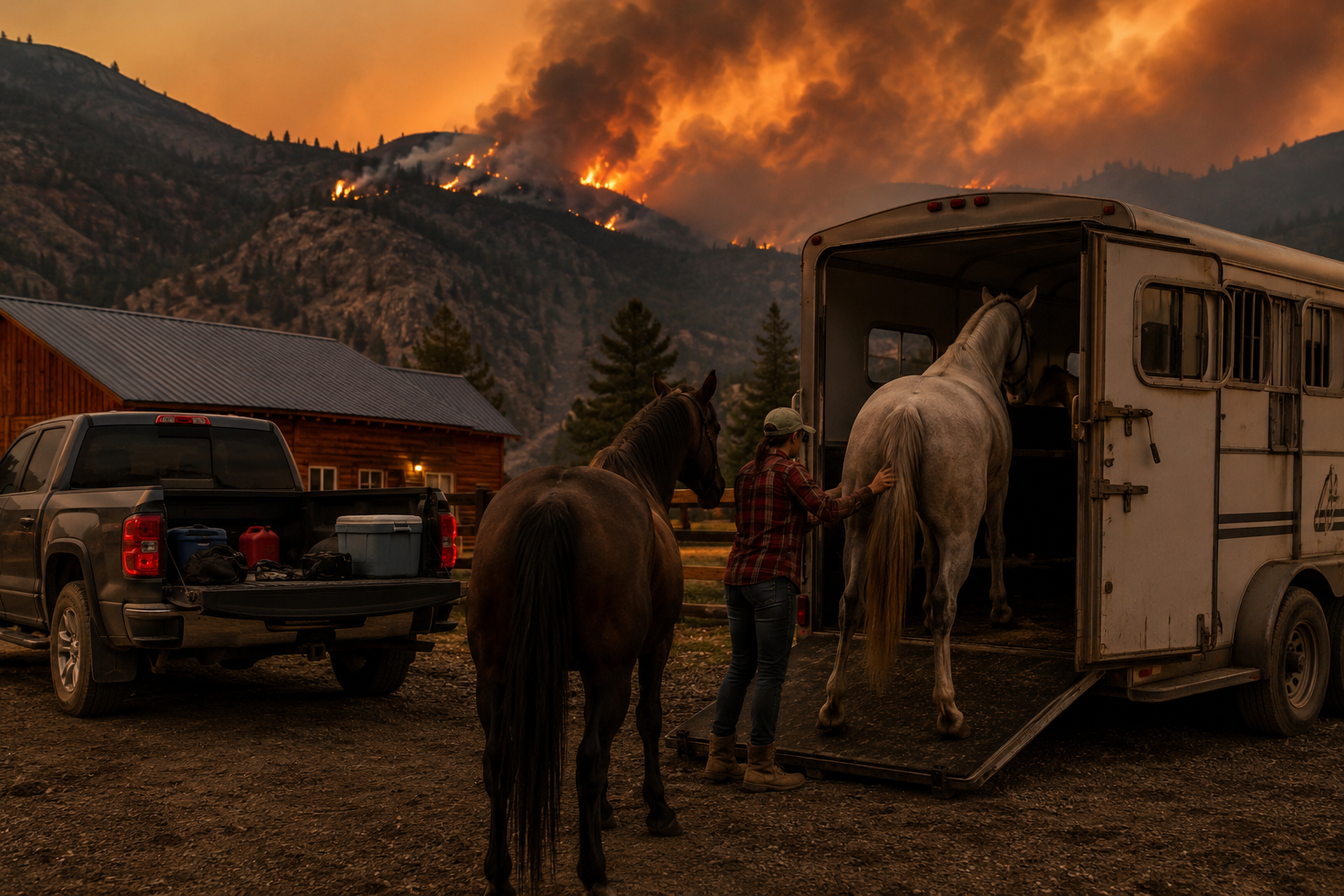
Wildfire Evacuation: Are You Actually Ready to Leave?
Every summer, it seems wildfire becomes part of life somewhere in Canada.
The smoke rolls in. The sky changes colour. We watch evacuation alerts appear on our phones and see heartbreaking photos of homes, farms and communities threatened by fire.
And every time, my heart breaks for the people living through it.
I find myself thinking about the firefighters working tirelessly in incredibly difficult conditions. I think about families waiting to find out if they still have a home. And, being someone with animals, I especially think about the people trying to evacuate horses, dogs, cats, chickens and livestock while everything around them is changing by the minute.
It makes you realize how helpless we can be when nature decides otherwise.
And it made me ask myself a very uncomfortable question:
If we were told we had to leave our home today, would we actually be ready?
Not theoretically.
If I had two hours. Thirty minutes. Or 10min …
Would I know exactly what to do?
That question is the reason I wanted to put this together.
This isn’t about living in fear of wildfire. It’s about making the difficult decisions now, while we’re calm, instead of trying to make them while we’re scared.
An Evacuation Alert Is Not the Time to Start Planning
One of the most important things we can do is understand the emergency information for our own community.
Know where your local authority posts official evacuation alerts and orders. Know what those notices mean and what you’re expected to do.
And don’t depend on Facebook rumours when things become serious.
Social media can be useful for community information, but during an emergency, official information should be your primary source.
Your evacuation plan should already exist before an alert ever arrives.
When the risk increases, you’re putting that plan into action—not inventing one.
First Question: Where Are You Going?
This seems obvious until you actually ask yourself:
If we had to leave tonight, where exactly would we drive?
Would you go to family, Friends, A hotel, A campground, An emergency reception centre?
And if you have horses or livestock, where are they going?
For rural families, “we’ll figure it out” isn’t much of an evacuation plan.
Have a Plan A.
Have a Plan B.
And preferably, have a Plan C.
Think about your normal route out of the area. Then think about what happens if that road is closed.
Know alternative routes. Consider downloading offline maps ahead of time in case cell service becomes unreliable.
If family members are separated when an evacuation happens, decide where you’ll meet.
Choose an out-of-area person everyone knows to contact if local communications become difficult.
These are tiny decisions today. During an emergency, they’re enormous.
My 10-Minute, 30-Minute and 2-Hour Plan
This is one of the simplest ways I’ve found to think about evacuation.
Instead of one enormous list of everything we might possibly want to save, ask:
What do I do based on the amount of time I actually have?
If I have 10 minutes
There is no wandering around deciding which photo albums I like best.
People.
Animals, if they can be safely evacuated.
Essential medication.
Phones, Wallet and identification.
Critical documents that are immediately accessible.
And we leave.
If I have 30 minutes
Everything above, plus:
Evacuation bags.
Animal supplies.
Computers and hard drives.
A few irreplaceable items.
Water and easy food.
Load the vehicles and trailers.
If I have a couple of hours
Now there’s more opportunity to put the larger plan into action.
Load livestock early rather than waiting until conditions deteriorate.
Load the things you’ve already identified as important.
Prepare the property only where official guidance says it is appropriate and conditions allow you to do so safely.
Do a final check.
And leave while you still have time.
The important part is this:
More time doesn’t mean we should stay until the last possible minute.
Things can change frighteningly fast.
Have a Go Bag Before You Need One
You don’t necessarily need some elaborate survival backpack worthy of an expedition.
You need the basics that will make the next 24–72 hours easier if you suddenly can’t go home.
Keep a bag ready, or at minimum keep a written grab list somewhere obvious.
Think about:
- Identification and passports
- Insurance information
- Essential medications and a medication list
- Phone chargers and power banks
- Cash and cards
- Spare keys
- Glasses or contact lenses
- Water
- Easy, non-perishable food
- A change of clothes
- Basic toiletries
- First-aid supplies
- N95 masks for wildfire smoke
- Flashlight or headlamp
- Clothing appropriate for the season
- Important phone numbers written on paper
- Comfort items for children
You don’t want to be trying to remember all of this when your brain is screaming at you to hurry.
Protect the Things You Can’t Physically Carry
This is something we can all do long before fire season.
Scan or photograph important documents.
Keep secure copies somewhere you can access even if your home and computer aren’t accessible.
That could include identification, insurance information, property documents, vehicle information, veterinary records, medication information and emergency contacts.
I also think doing a video inventory of your home is incredibly worthwhile.
Walk through your house.
Your garage.
Your shop.
Your barn.
Record your belongings and major equipment. Photograph serial numbers on expensive equipment.
Hopefully you never need any of it.
But if you’re ever trying to reconstruct what you owned after a disaster, you’ll be grateful you did it.
Pets Need Their Own Evacuation Plan
Our animals are family, but they also make evacuation more complicated.
Make sure carriers aren’t buried somewhere underneath twelve Christmas decorations and a broken vacuum cleaner.
Keep leashes and harnesses accessible.
Have food, bowls, medication and basic supplies ready.
Keep identification current.
Keep recent photographs of your animals, and consider having photographs showing you with them as part of your records.
And know ahead of time where you can actually take them.
Not every hotel, shelter or accommodation will accept animals.
Finding that out while you’re sitting in a loaded vehicle with three dogs isn’t ideal.
Horses Change Everything
This is the part that really gets to me.
I’ve heard stories during wildfires of people unable to evacuate all of their horses and having to make decisions no horse owner ever wants to make.
Imagine having to leave your property and not knowing where your horse is—or whether you’ll find them again. I don’t want to figure out my horse evacuation plan while smoke is rolling over the property.
If you have horses, start asking questions now.
Where would they go?
Who nearby has a trailer?
Who could help you haul if you don’t have enough trailer space?
Who could temporarily take your horses?
What happens if your first destination is also under threat?
And please, practise loading.
An emergency is not the day to discover your horse has decided the trailer is a fire-breathing dragon. Keep your trailer accessible and maintained. Check tires, spare tire, lights and brakes. Keep halters and lead ropes somewhere obvious.
Keep current photographs of each horse from both sides and document distinguishing markings. Keep registration, microchip and veterinary information where applicable.
Have medication, basic first-aid supplies, buckets and whatever feed or hay is practical to take.
And have an identification system prepared in advance.
If you’re considering attaching emergency identification to a horse, research the current recommendations from your local emergency and livestock authorities before fire season. Have your contact information ready, including more than one phone number.
There is also a much harder question every livestock owner needs to consider:
What happens if I physically cannot evacuate every animal?
That isn’t something I want to give casual internet advice about. Talk to your veterinarian, local livestock organizations and emergency authorities about the safest options for your particular animals and property before you’re faced with that situation.
Don’t Forget Chickens, Ducks and Other Livestock
We talk a lot about evacuating dogs, cats and horses.
But what about twenty chickens?
Ducks, Goats, Sheep etc?
How are you actually transporting them?
Do you own enough crates?
Where are those crates right now?
Where will the animals go?
What will they eat and drink when they get there?
This is another reason relationships with neighbours, farmers and other livestock owners are so valuable.
Make arrangements before you need them.
And if possible, practise putting your animals into whatever you’re planning to transport them in. Because an evacuation order is a spectacularly bad time to discover your rooster has chosen violence.
What Would You Take From Your House?
Here’s an exercise worth doing.
Imagine someone tells you:
You have 15 minutes.
What would devastate you to lose that could reasonably fit in your vehicle?
Not the tv nor your toaster ..
I’m talking about the things that cannot really be replaced.
Family photographs, Hard drives, Jewellery with sentimental value, & Heirlooms.
also – Important documents & Objects that belonged to someone you loved.
Write the list now.
Keep it on your phone and and keep a paper copy somewhere accessible.
Because under stress, you’re not going to think the way you’re thinking while calmly reading this.
What If You Aren’t Home?
This may be one of the biggest holes in rural evacuation plans.
Imagine you’re 45 minutes away from home.
Your phone goes off.
Evacuation Order.
Your dogs are home and the horses are in the pasture.
Now what?
Who has permission to access your property?
Who has a key?
Who knows your animals well enough to handle them?
Do they know where the carriers, halters and lead ropes are?
Could they safely catch or load your horses?
Do they know where the animals are supposed to go?
And who’s your backup if that person isn’t available?
Our evacuation plan shouldn’t depend entirely on us being standing in the kitchen when the order arrives.
I think every rural household with animals should have emergency instructions somewhere obvious and at least one trusted person who knows the plan.
Your Vehicle Is Part of the Plan
During periods of elevated wildfire risk, don’t make evacuation harder by routinely leaving vehicles almost empty.
Keep useful fuel available.
For an electric vehicle, the same principle applies: maintain enough charge to leave the area if necessary.
Know where the keys are—and make sure everyone in the household knows.
If conditions are becoming concerning, think about how vehicles and trailers are parked.
Don’t trap the horse trailer behind equipment you’ll have to move before you can even hitch up.
And maintain your equipment.
A flat trailer tire is annoying on an ordinary Tuesday.
During an evacuation, it could be a serious problem.
Build a Neighbour Plan
This might be one of the most valuable things rural communities can do.
We already help each other.
Why not actually talk about evacuation before something happens?
Who owns trailers?
Who has room for horses?
Who has livestock crates?
Who has a generator?
Who has a truck?
Which neighbours may need help?
Who is elderly or living alone?
Who could open gates or check animals if someone isn’t home?
You don’t need to create some complicated organization.
Five neighbours sitting around a table with coffee could create an incredibly useful informal emergency network in an hour.
And that might matter far more someday than any piece of emergency equipment you buy.
Prepare the Property Before Fire Season
Evacuation day is not the time to begin thinking about wildfire resilience around the property.
That work belongs before fire season.
Learn the FireSmart principles appropriate for your area.
Think about vegetation and combustible material around structures, access for emergency vehicles, visible address signage, driveway access and the way fuel, propane and other materials are stored.
Take photographs of your property and buildings before fire season.
And understand what emergency officials recommend for rural properties in your particular region.
Property preparation deserves an entire conversation of its own.
Even a Fire Miles Away Can Affect You
You don’t necessarily need flames approaching your property before wildfire preparedness matters.
Smoke can become dangerous.
Power can be interrupted.
Roads can close.
Cellular service can become unreliable.
Communities can suddenly become much busier as people evacuate from somewhere else.
Supplies can become harder to access.
So even when the fire isn’t “our fire,” it’s worth paying attention.
Preparedness isn’t only about saving a house.
It’s about making yourself less vulnerable when normal systems stop behaving normally.
The Hardest Decisions Should Already Be Made
I don’t prepare because I believe our home is going to burn down.
I prepare because I never want to be standing here, scared and overwhelmed, trying to decide what matters while precious minutes disappear.
Before an emergency, I want to know:
WHO we’re taking.
WHAT we’re taking.
WHERE we’re going.
HOW we’re getting there.
WHAT happens to every animal.
And WHO steps in if we aren’t home.
Everything else is secondary.
Because when you really think about what you would save from your home, the list gets surprisingly short. The animals and The people you love.
A handful of things that can’t be replaced, and yourself .
Homes can be rebuilt. Things can be replaced.
But no possession is worth getting trapped for.
Stay Safe,
Diana
ps.. here is a video

Thank you